Fire on Board
Fire on board an aircraft is an extremely dangerous hazard. With powerful engines and the carrying
of large quantities of fuel on board, a certain risk clearly exists. This was especially true in the early days of aviation.
Since then, aircraft manufacturers have made great progress in minimizing the risks of fire. The materials for cabin fittings are carefully
chosen, smoke detectors give an early warning to the flight crew and fire extinguishers are readily available on board to deal immediately with any
minor incidents in the cabin. Moreover, there a re strict rules to what goods passengers may carry on board or place in the cargo hold. Fire outside the
cabin (in the cargo hold or in one of the engines) can usually be put out quickly by use of strategically-placed fire bottles, controlled from the cockpit, provided of course
that the fire can be detected soon enough.
Dangerous goods
All airlines must comply with the ICAO regulations regarding the transportation of dangerous goods. These are usually materials which may be safety stored in your house or garage. On board an aircraft, however, they may present an unacceptable risk. This is because they will be subjected to extremes in atmosphere pressure and temperature at a typical cruising level, as well as excessive vibration at times.
The policy of airlines is to take no risks and to ban any goods which might cause a problem, even if the possibility is remote. They have strict screening procedures to ensure that the regulations are obeyed. Indeed the greatly increased security measures in place since September 11, 2001 have made things safer in this respect.
Evacuation procedures.
When an aircraft carries out an emergency landing, fire-fighting services should be on standby to deal with any fire which might break out. One major risk is that of the aircraft being unabie to stop before the end of the runway. This is known as a runway overrun and the airplane may catch fire if it crashes into something. In such cases passengers will need to be evacuated without delay. Cabin crew are trained for this scenario and the rules governing the availability of emergency exits and escape chutes on all aircraft are strict. If the cabin is filled with smoke, the strip lighting on the floor will guide passengers to one of these exits.
In August 2005. an Airbus A340 skidded off the end of the runway at Toronto airport in severe weather
conditions and plunged Into a ravine. Fire broke out immediately, but all 309 passengers and crew were able to escape unharmed. The cabin crew were highly
praised for being able to evacuate the airplane as fast as they did. Regulations state that an emergency evacuation of an aircraft should be possible within 90 seconds. Training
exercises are conducted regularly. New aircraft need to be certified for their capacity m meeting this standard (that is emergency exits need to be we^l-placed and should be
sufficient in number). There was some doubt about how the new Airbus A380 might meet this standard with its record-breaking passenger capacity. In a simulated exercise in
Germany, in 2006. 873 volunteers were all able to escape down the emergency slides in Just 80 seconds. There were strict rules for this simulation. The cabin was darkened
and half of the emergency exits (chosen at random) were blocked and so out of serv>ce. The volunteer passengers were chosen to be
representative of the average passenger toad - 35% were over the age of 50 and 45% were women. The exercise was recorded on infra-red cameras to be subsequently validated
by a panel of experts. The risk of injury even during a training exercise such as this is considerable. One volunteer sustained a broken leg but organizers
had feared that there would be more injuries.
Air traffic control and fire-fighting services
When a fire breaks out on board an aircraft, it is the pilot's responsibility to deal with
the situation. The pilot may declare an emergency and may need to land as soon as possible. In this case the
air traffic controller will need to make sure that the fire service are standing by on the ground and
that they
have as much information as possible about the problem. The importance of the fire service being
able to act as soon as the aircraft lands cannot be overstated.
Even when there is no actual fire on board, a controller may need to alert the fire service if a pilot is making an emergency landing, as in many emergency situations there is a real risk of fire breaking out.
Listening 1.29
Listening 1.30
Listening 1.29
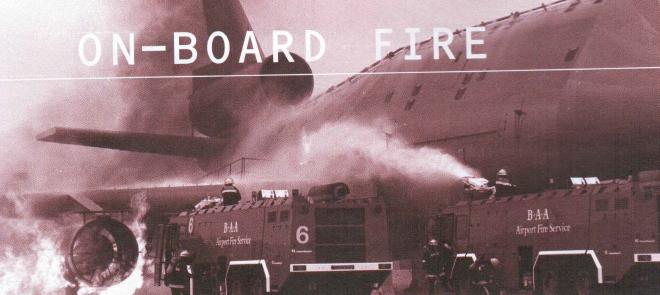
This is a picture of an airport fire-service
training exercise.
There is a mock-up aircraft which is made to look like a
DC-10. The starboard engine is engulfed in flames and
there appear to be some flames over the right wing,
close to the main fuselage. The fire is producing quite a
lot of black smoke which is
dispersing towards the
of the aircraft structure. There are two large six-wheel
fire appliances attending to the situation,
both on the
right-hand side of the aircraft. Each of the appliances
has various firemen around it, and fire fighters on top of
the appliances. The appliance on the right-hand side is
starting to spray water or foam onto the aircraft structure
using the roof-mounted fire hoses. Both trucks have "BAA
Fire fighting service" written on the side which makes me
think that the picture was taken in the United Kingdom.
Listening 1.31
Listening 1.31
Nohma Tower. Fastwing 64. We are maintaining
altitude 5.000 and we we cleared now to 2.500 ft
on QNH 1010 millibars. We are starting our descent
to Nohma now Fastwing 64.
Fastwing 64. Nohma tower Roger. We understand
you have a fire. Cleared visual approach runway
07, I confirm the QNH is 1010 millibars. Report
maintaing 1.500 ft. We have emergency services
standing by. Is it a cabin fire?
In our mid lav Fastwing 64.
Fastwing 64. Confirm that the fire is in your middle
lavatory?
Affirm. We deployed halon but we are going to
continue the mayday call.
Fastwing 64. Roger.
For your information ... we will make a complete ,
stop on the runway, we will evaluate the
situation
then ... and if we are not going to evacuate on
the
runway we will return to parking by ourselves and
stop the aircraft there. Fastwing 64.
Fastwing 64. That's copied. Confirm field in sight?
Affirm. Fastwing 64
Fastwing 64. Cleared to land runway 07. Wind is 120
at 22 kn.
Cleared to l and runway 07. Fastwing 64.
Tower. Fastwing 64.
Fastwing 64. Pass your message.
As it looks now, we are able to taxi to
our parking
position. We have a signal from the cabin that
everything's OK now. Fastwing 64.
Fastwing 64. Roger. Proceed to the isolated parking
position via L31, The emergency services will follow.
We'll call ground services for your arrival.
Listening 1.30
We have a large fleet of appliances at
our station at Bijarati
International.
First on the list are the "High-volume
pumping vehicles".
These are capable of carrying an enormous amount
of foam, and then applying it under massive pressure
and volume. They are equipped with a "roof-mounted
high-volume monitor" or 'nozzle*' which can shoot fire
extinguishing media a long way to reach the fire.
Another piece of equipment is the "Snozzle",
which has
recently been introduced at Bijarati. This type of roof-
mounted monitor has a device resembling a spike that can
pierce the fuselage of an aircraft and deliver large amounts
of water and foam inside the aircraft. This makes airport
firefighting safer, as firefighters do not need to set foot
inside the aircraft to extinguish fires.
Then we have these "Rapid intervention
vehicles" which
are capable of arriving at the scene of an incident more
quickly. We also use these smaller vehicles as command
vehicles during rescue or firefighting operations.
Our airport is category ten, meaning that
we are able to
handle the largest aircraft, such as the A380. As part of
the regulations for category ten airports, we also keep an
"Aerial ladder pl a t for m" c apable of reaching the upper deck
of the A380.
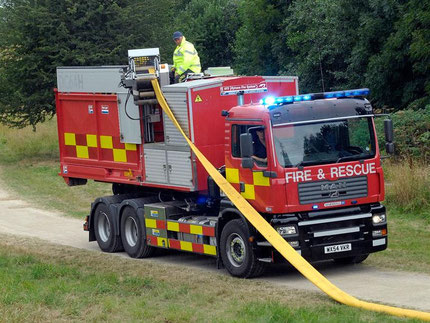
The fleet is also supported by "Smaller
fire appliances"
similar to those used in domestic fire fighting. They are
mainly used to deal with incidents within the buildings
around the airport, but also assist at aircraft incidents.
Aerial Ladder Platform

High Volume Pumping Vehicle
Smaller Fire Appliances

