Runway incursion
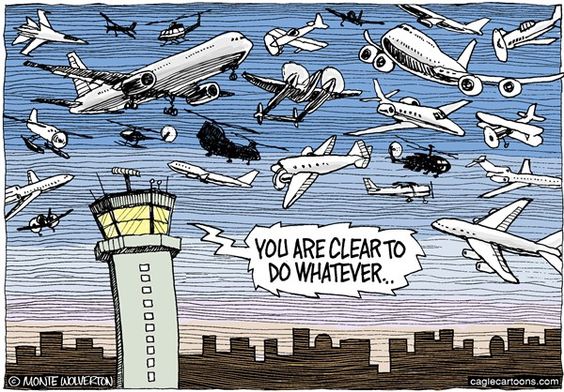
A runway incursion is the unauthorized entry onto a runway by an aircraft, a vehicle, a person or an object. In such situations there is a serious danger to any airplane which may be taking off or landing. A runway incursion might be caused by an operational error on the part of an air traffic controller, a pilot deviating from issued instructions or by the driver of an airport vehicle.
Airports are divided into airside and landside areas. Airside areas are where the airplanes can be found. These include runways and taxiways as well as stands, where aircraft are parked for providing direct access to the terminal building through an air bridge or jetway. The airside area also includes the apron, where several aircraft may park at a distance from the terminal building (buses then take passengers to and from the aircraft). Access to all airside areas is subject to tight security controls. Landside areas, on the other hand, which include shops, restaurants, car parks and check-in areas, are more accessible to the general public.
Air Traffic Control (ATC) is usually provided from a control tower situated on-site. At major airports ATC is separated into ground control (responsible for aircraft and all other vehicles using the apron and taxiways) and tower control (responsible for aircraft landing and taking off on the runways). Approach control handles aircraft which have just taken off or are about to land. En route traffic is controlled at an area control centre, which can be situated anywhere, as the aircrafts are only visible on a controller's radar screen.
Runways
Small airports may have only one runway but most
major airports have several. When a new airport is built or an existing one expanded, runway layout is of primary concern.
Runways need to be laid out to make optimum use of the prevailing winds because aircraft need to take off and land
directly into the wind if possible. Crosswinds can be a dangerous hazard. Assuming that
the airport will be busy, the layout should also be efficient, ideally allowing runways to be used
simultaneously.
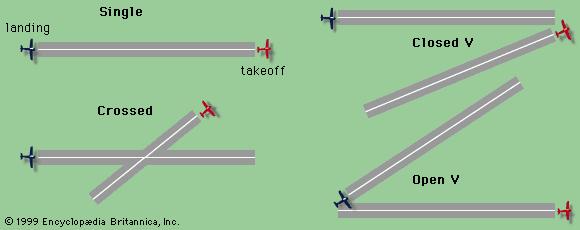
The three main runway configurations are parallel
runways, open-V runways (they diverge but do not intersect; when
viewed overhead the shape is a 'V'), and intersecting runways. The latter two
types are relevant in locations where the direction of the prevailing wind changes.
Runways are labelled depending on their direction relative to the magnetic compass (to the nearest
10°, with the zero
left off). This number is clearly indicated at the end of each runway. If a runway
is labelled 09 at its starting point (runway threshold) because it runs due east (90°), then it will be
labelled 27 at the other end which is the runway threshold should the pilot
need to land in a westerly direction (270°). In this way, when a wind reverses direction, landings and take
offs follow suit. All runways are thus designated by two numbers the difference
between which is 18. For example, on runway 13-31 pilots can either land or take off with
a heading of 130° or 310°.
At international airports all runways must have ground markings and standardized lighting according to agreed international standards.
The threshold and direction of a runway should be clearly marked as well as the touchdown zone and distance markers at various points to show a pilot how much runway is left. The centre line should also be clearly visible as well as the runway exits leading to taxrways.
Standardized lighting is as follows:
• Green threshold lights mark the beginning of a runway.
• Red lights mark the end of a runway.
• White or yellow lights mark the edges of a runway.
• Blue lights indicate taxiways.

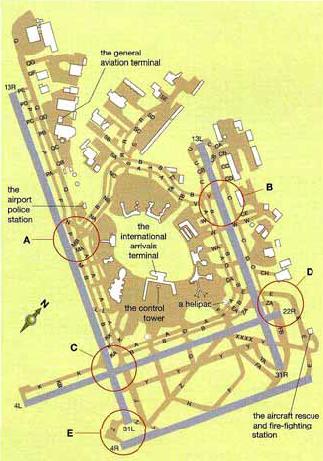
Our first hotspot is taxiway E as we approach from taxiway C en route to runway 22R. The signage is confusing, and a blast fence blocks the view of the end of the runway. Aircraft taxiing to 22R via C often turn left too soon and end up on taxiway E. This can mean a very long taxi behind 22R.
A second problem area is taxiway Z crossing runway 13R /
31L. A right turn is required when crossing 13R to taxiway Z on the opposite
side. There are two taxi lines leading across. If you follow the wrong one, you could end up with a conflict
with arrival traffic on runway 13R.
In this situation, advise ATC immediately and get off the runway as quickly as possible.
A third area of concern is using Juliet to transition from A to B south-east bound Aircraft outbound from K and KK may sometimes be issued the instruction "Taxi left A. At J. transition to B."
It's very important not to miss the turn onto B, because J leads across runway 22R.
Anatomy of an Airport's Landside