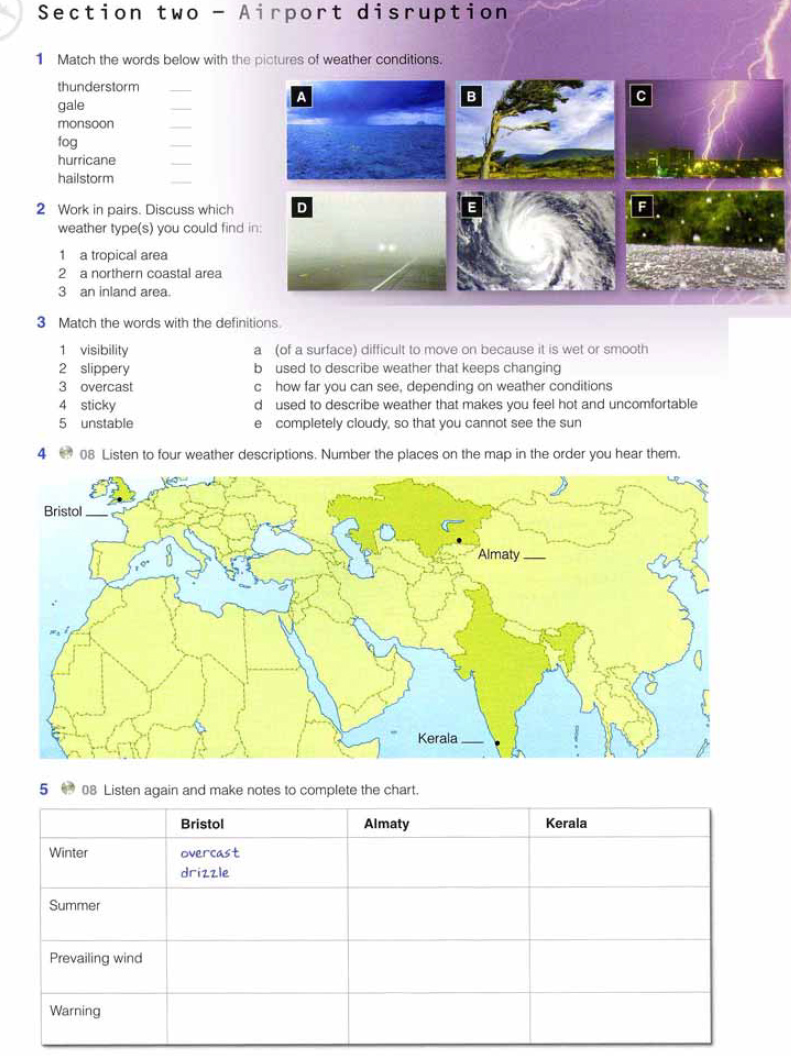
Weather Conditions
KEY TERMS : VMC - IMC - PIREPS - TAF - WIND SHEAR - LOW VISIBILITY - RVR

Introduction
Weather is of crucial importance to pilots, both in flight planning
and in the safe operation of a flight and it affects air phases of flight. Modem aircrafts are undoubtedly much better
equipped to deal with different meteorogical conditions than the machines which took to the air in the early days of
powered flight. Weather reports are also a lot more reliable. None the less, pilots of today's jet airlines need to
deal from time to time with several potential dangers presented by bad weather.
Weather reports
Clearly weather reports are of great importance to pilots. They
need to be informed of the conditions at the departure airport,
along their planned route (known as a route forecast) and at
their destination. Weather conditions can change and pilots
need updated weather reports. PIREPs (pilot reports) are
sent by pilots who have recently flown through an area and
can keep other crews usefully informed. Terminal aerodrome
forecasts (TAF) are continually updated and allow pilots to
predict the weather at their destination.
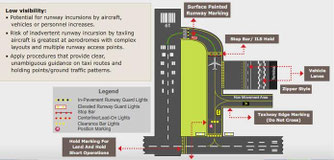
Low visibility
Air traffic can come to a complete halt at a fogbound
airport. IFR traffic can usually take off reasonably safely
in fog. but the problem is that landings may not be
authorized until the fog lifts, thus effectively paralysing the
airport (no inbound aircraft eventually means no outbound
aircraft). This is especially the case for smaller airports.
The regulations concerning landing in low visibility depend
on the navigational aids available at a particular airport,
the type of aircraft involved and the qualifications of the
pilot. At a well-equipped airport it is possible to land even
if the pilot cannot see the runway beforehand. For smaller
airports and less well-equipped aircraft, visibility will need
to be above landing limits, that is there is a minimum
altitude at which the pilot will need to be able to see the
runway. There will also be a stricter requirement for RVR
(Runway Visual Range), which is visibility along the
runway once a pilot has landed.
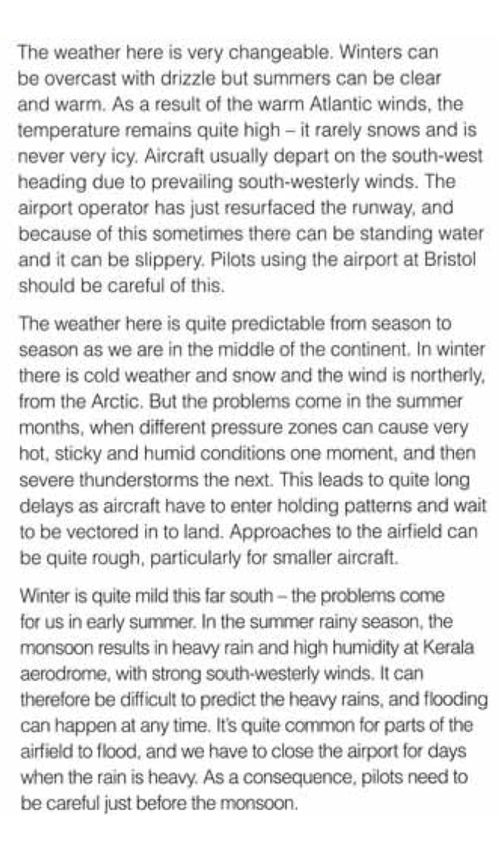
VFR flights are much more dependant upon good weather. . Indeed VFR
flying is only permitted in VMC (Visual Meteorological Conditions) that
is in conditions of clear visibility when the pilot can both see and be seen. Nevertheless, frequently a VFR pilot
will take off in VMC but conditions change to IMC (Instrument
Meteorological Conditions) for which he / she is neither
equipped nor qualified. A VFR pilot who is not assured of
suitable weather conditions along the planned route should
not leave the ground. IFR flying is possible in most weather
conditions but there are still some constraints, e.g. no pilot, no
matter how well-trained, nor how sophisticated their aircraft
might be, should knowingly fly through a thunderstorm.
Wind and wind shear
Forecast wind strength and direction is a major factor
in flight planning, and the navigation will need to be
constantly updated to take into account the actual wind
experienced. Aircraft should, as far as possible, land into the wind. Crosswinds can make landings much more difficult but they may be unavoidable at an airport which has only one runway, or
two or more parallel runways.
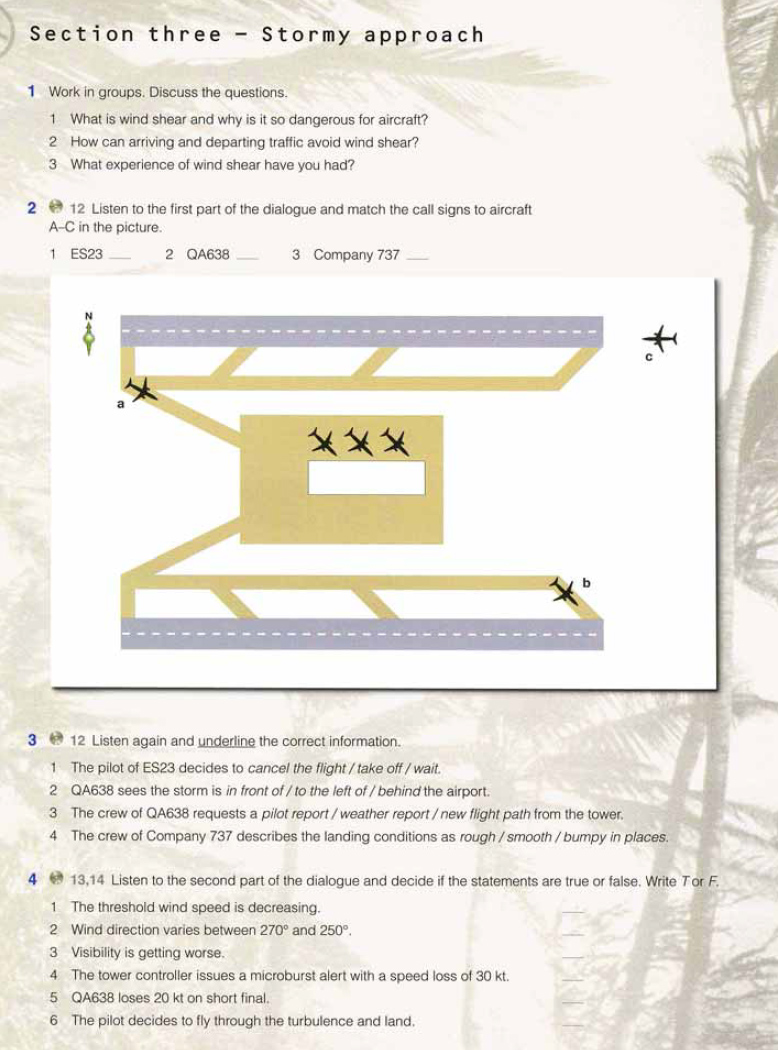
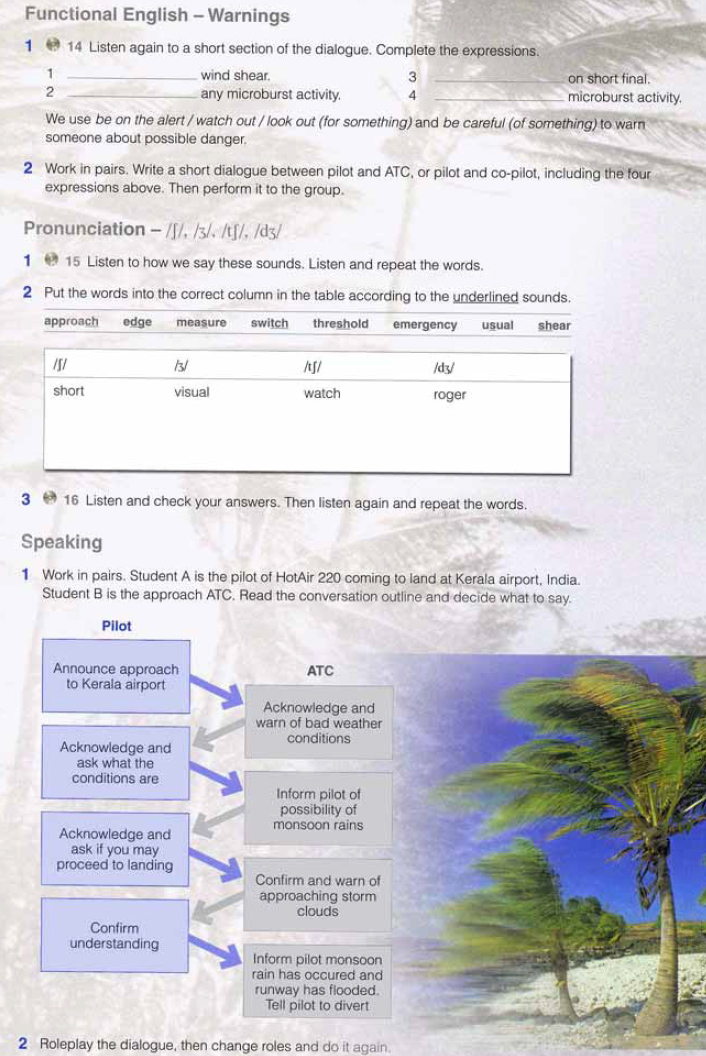
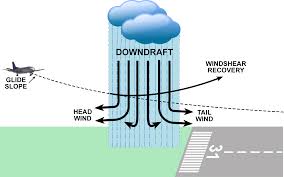
Another danger presented by wind is the phenomenon
known as wind shear. This occurs when two winds moving
in opposite directions meet. The result can be severe
turbulence and a loss of control. While wind shear can
occur at any altitude, an airplane is most vulnerable when
it is coming in to land. When wind shear can be predicted,
it will be less threatening than when it occurs suddenly and
the flight crew are unprepared. Controllers will do their best
to warn pilots of any known wind shear activity near their
airport. A pilot who is forewarned of this danger will almost
always choose to go around, that is to climb and try to
reposition for another attempt at landing, or to divert to
another airport.